

Topline
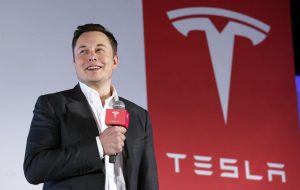
Tesla beat Wall Street expectations in its first earnings report this year, following a recent decline in its core auto business as the company shifts its focus to self-driving taxis, humanoid robots and AI infrastructure.
Key Facts
Tesla reported first-quarter revenue of $22.39 billion and $0.41 earnings per share, beating FactSet estimates of $22.19 billion and $0.35 per share.
The company said in a statement Wednesday that demand for its vehicles is rebounding in North America and Europe-Middle East regions while growth continues in the Asia-Pacific and South America regions, although it reported its second-worst quarter for car sales since 2022.
Tesla delivered just over 358,000 vehicles in the first quarter, up 6% year-over-year, but missing the company’s compiled consensus of 365,645 and FactSet projections of 381,000.
Capital expenditures increased 67% from the first quarter in 2025 to $2.49 billion as part of the company’s plan to spend $20 billion this year, more than double last year’s $8.5 billion, to fund its business pivot.
Shares rose 4% in after-hours trading but are down 11% this year, underperforming the rest of the “Magnificent 7” tech stocks including Apple, Microsoft, Alphabet, Amazon, Meta and Nvidia.
Key Background
The quarter caps a difficult stretch for Tesla’s core auto business. Full-year 2025 revenue fell 3% to $94.83 billion—the company’s first-ever annual revenue decline—while earnings per share collapsed 47% to $1.08 as the company experienced its second annual decline in vehicle deliveries. Tesla’s founder and CEO Elon Musk has pivoted the company away from its core electric car business this year amid declining sales, redirecting toward robotaxis, humanoid robots and AI infrastructure. The brand has struggled with increasing competition, especially from Chinese EV makers, aggressively taking market share and customer backlash from Musk’s involvement with the Trump administration. This year, the company announced it planned to end the production of its Model S and Model X vehicles, instead using the manufacturing facility in California that made those cars to produce its line of humanoid robots. It also said it would make a $2 billion investment in Musk’s AI venture xAI. On April 18, Tesla announced plans to expand its robotaxi business, which currently falls behind Alphabet’s Waymo, beyond California to Houston and Dallas (Tesla’s current robotaxi service in California is operated by human drivers or with human safety supervisors). In the first quarter, Musk also merged SpaceX and xAI in a deal valued at $1.25 trillion as he gears up the combined companies for a potential record-breaking IPO.
Read the full article here