



Darcy is the CEO at Buttonsmith Inc., using software and networks to rebuild US manufacturing for the 21st century.
As the CEO of a small manufacturing company, I have spent years competing with larger, better-capitalized manufacturers halfway around the world. Right now, we are at a sudden inflection point in which new AI technologies are likely to make being small and agile a significant advantage, providing clever smaller manufacturers with opportunities to leapfrog ahead of bulkier competitors.
For the past several decades, advantages in manufacturing could be gleaned by embracing three key concepts in the lean manufacturing methodology:
• Single-Minute Exchange of Die (SMED), which is focused on reducing the costs associated with changing from one process to another.
• Kaizen, which focuses on continuously identifying ways to improve processes.
• Root cause analysis, in which the causal chain is analyzed to figure out where problems originate and treats them at the source, rather than merely treating symptoms.
All three of these concepts can benefit significantly from the application of new AI technologies that will be accessible to even small manufacturers. The upfront costs of the expertise needed to deploy automation and digital manufacturing technologies is about to drop, allowing digital SMED through robotics, automated kaizen and analytics-driven root cause analysis.
Robots As SMED
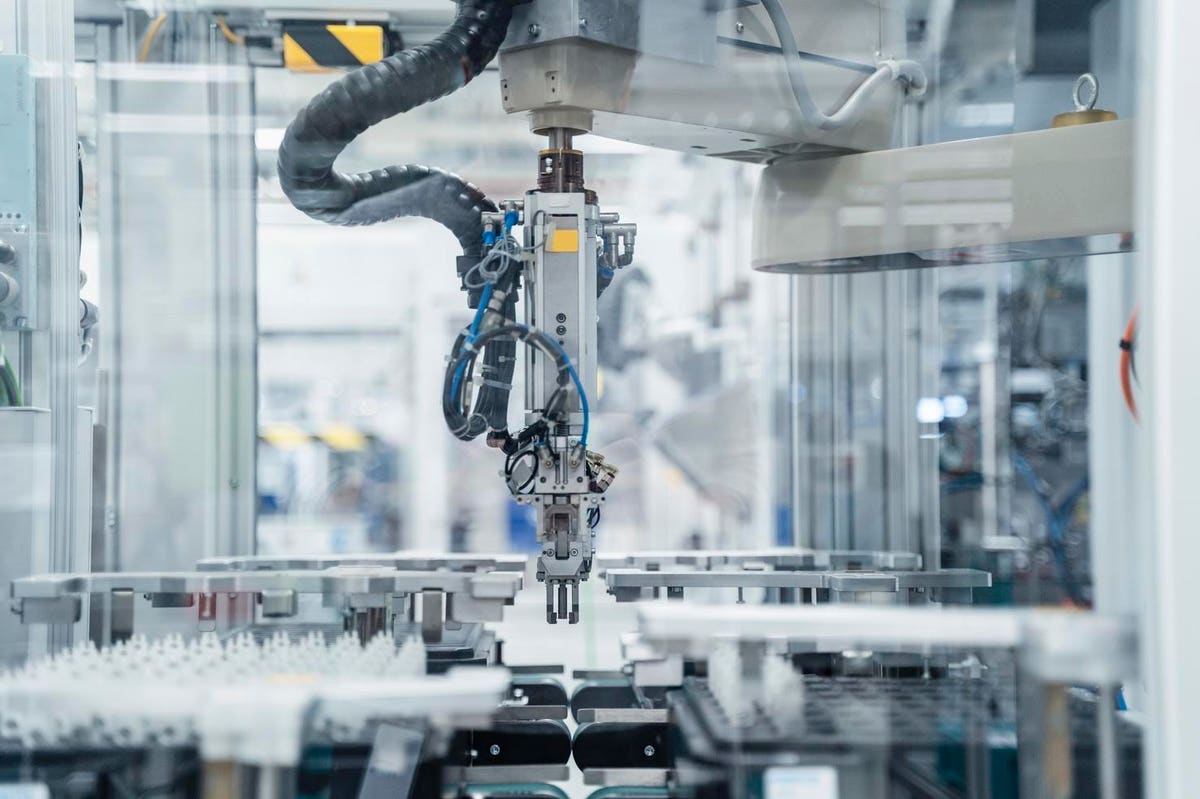
One of the key opportunities to improve manufacturing efficiency lies in deployment of general-purpose robots rather than purpose-built machinery for assembly automation. General-purpose industrial robots with flexible parts-feeding systems can realistically be used to make assembly lines that, rather than requiring a rebuild on the factory floor, can switch from one type of item assembly to an entirely different part or process instantly via software.
Up until now, most small and medium manufacturing environments faced integration costs for robotics that are frequently a factor of three to five times more expensive than the robots themselves. Now, however, anyone with a ChatGPT+ subscription has access to the ability to generate the code that drives these robots. As the technology progresses, the use of GitHub Copilot, Google’s Bard, or the regularly evolving stream of interfaces available from OpenAI and Microsoft are likely to rapidly improve the effectiveness of this approach.
Analytics For Kaizen
In addition, AI-enabled robots can practice the core principles of kaizen, learning from their own experiences and adapting to their environment, which can further reduce integration and programming costs. Instead of requiring extensive manual programming for each specific task, these robots can use AI algorithms to analyze their own performance data, identify patterns and optimize their actions accordingly.
As a result, these self-learning robots can become more efficient and effective over time, reducing the need for costly manual adjustments and programming updates. This should also allow manufacturers to be more flexible in their production processes, as AI-powered robots will be able to more easily adapt to new tasks or changes in the production environment.
Analytics For Root Cause Analysis
The application of AI-managed analytics can also be used to identify where problems or opportunities for process improvement are, as well as to address maintenance and repair needs more efficiently. Software that continuously monitors all of the data in the business, from sales data and manufacturing processes to information about repairs and customer support, should be capable of automating improvements in every part of the business, pulling customer satisfaction data and reliability issues all the way back to the improvements needed at the point of manufacture to fix a problem at its source.
First Steps
There are several steps that companies can engage in now to begin to get a handle on what’s coming and what’s possible.
1. Identify a curious champion.
Find someone in your organization who understands your processes and equipment well and is curious about the possibilities of both robotics and AI. Encourage them to begin to experiment with what’s possible through the publicly available interfaces offered by OpenAI, Google, Microsoft and other providers, and to participate in the discussions happening online in places like Reddit and Twitter, where other experimenters are talking about what they’re doing and what kinds of results they’re getting. These discussions often follow the latest developments by mere hours, and people are excited to share.
2. Experiment and play.
The costs to access most of the new AI models currently ranges from free to very inexpensive. Sign up for and experiment with the tools available from all of the major providers, including Google, OpenAI, Microsoft, Amazon, Facebook and anyone else who jumps in with interesting technology in this space. If you already have a license for a tool that integrates with some of the models, like Zapier or GitHub, use the integrations to see what you can do. Test them for your purposes. Ask them questions that would otherwise be time-consuming for you to determine the answers to, and check the quality of their answers. The space is moving ahead so quickly right now that what is possible next week is likely to be significantly different than what is possible this week, so spending some time diving in regularly is likely to yield new and surprising outcomes.
3. Verify your results, and be cautious with your data.
The current AI models have a known problem with what is colloquially called “hallucinations”: If they don’t know an answer, they may make it up. It’s critical that you test the validity of anything generated by one of the models and don’t simply accept it at face value.
In addition, there are concerns about the models using proprietary data from users to feed back into the models, and potentially back to anyone in the world after that. Ensure that you and your staff are thoughtful about not putting in any of your data that is extremely sensitive or proprietary.
4. Nurture your excitement.
Manufacturing has traditionally been slow to adopt new technologies and has not been at the forefront of investors’ minds when considering opportunities for significant ROI. But what we’re seeing now, and what we’re likely to see in the next few years, has the potential to change manufacturing at a scale not seen since the dawn of the industrial revolution. So don’t be afraid to embrace your excitement over these new opportunities!
Forbes Business Council is the foremost growth and networking organization for business owners and leaders. Do I qualify?
Read the full article here