


In this week’s edition of The Prototype, we look at a cleaner way to make ammonia, some of the brightest young scientists in North America, magnetically charging your care, and more. To get The Prototype in your inbox, sign up here.
Ammonia is a crucial ingredient for the planet’s food supply—more than two-thirds of it is used to produce fertilizer. It’s also increasingly being seen as a potential clean energy source, with startups like Amogy using it to produce power for maritime and industrial applications. But while burning ammonia for fuel may be clean, making it isn’t—it relies on a fossil fuel dependent chemical reaction called the Haber-Bosch process, which accounts for nearly 2% of carbon emissions annually.
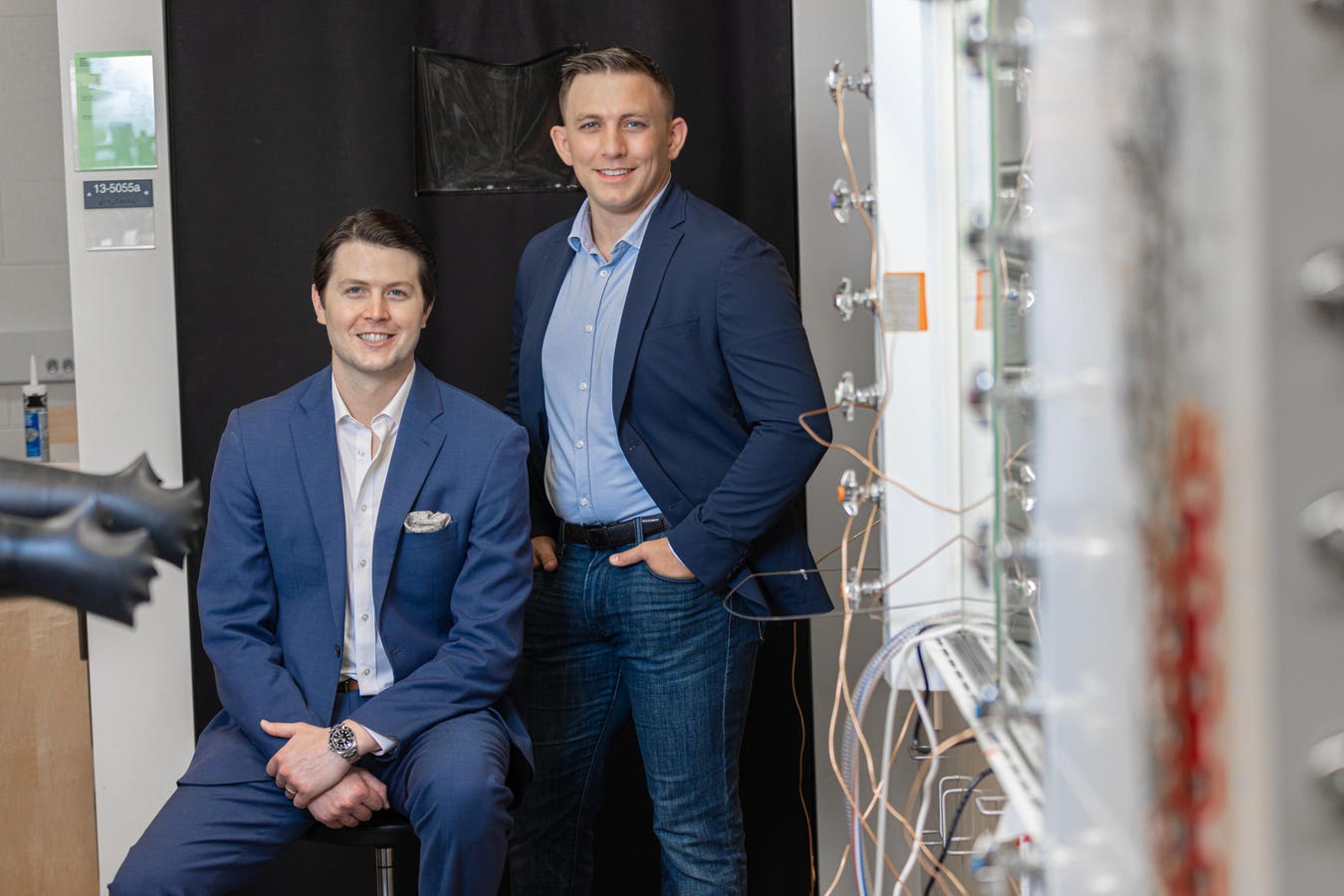
That’s where Michael Alexander and Charlie Mitchell come in. Their company, Addis Energy, aims to use the Earth itself as a chemical reactor to make ammonia in a cleaner way.
Here’s how it works—first, they identify rocky formations underground with large amounts of iron. Then they inject those rocks with water, nitrogen and a chemical catalyst. That causes the oxygen in the water to bind with the iron in the rocks—making rust—freeing the hydrogen, which reacts with nitrogen to form ammonia.
The advantage of this, Alexander and Mitchell told me, is that once they’re able to achieve this reaction at scale, it will produce ammonia at one-third the cost of the conventional process, which requires natural gas subjected to high temperatures and pressure.
On Thursday, the company announced an $8.3 million seed round, led by At One Ventures, bringing its total raised to over $17 million. Existing investors Engine Ventures and Pillar VC also participated. The company plans to use the capital to continue development of the technology and perform its first pilot operation in the field.
30 Under 30 Science 2026: New Discoveries From The Cosmos To The Nanoscale
Astronauts are among the most highly trained people in the world. Most of them have advanced degrees, not to mention years of experience in highly demanding military or technical fields. Sending them to the International Space Station is expensive—it costs around $130,000 an hour to keep its crew in orbit.
But despite all this expertise and expense, astronauts spend a great deal of time doing menial, tedious work such as routine maintenance or moving and organizing cargo. Ethan Barajas, 22, and Jamie Palmer, 25, want to fix that. Their company, Icarus Robotics, is developing robots that can do the grunt work so that the station crew “can focus on the groundbreaking discoveries that only astronauts can do,” he says.
Barajas and Palmer are just two of the innovators on this year’s 30 Under 30 Science list, which highlights some of the hottest young scientists, engineers and deep tech entrepreneurs.
Read more about the list here, and check out the complete 30 Under 30 Science list here.
DISCOVERY OF THE WEEK: WIRELESS EV CHARGING
Magnetic charging of phones has become commonplace—and your electric car may not be far behind. A team of researchers at the Swiss Federal Laboratories for Materials Science and Technology developed a magnetic plate that transfers energy to a receiver in the car. When tested under real world conditions, it showed the same efficiency as a cable, and can get started as soon as the car is correctly parked.
WHAT ELSE I WROTE THIS WEEK
In addition to co-editing the 30 Under 30 Science list, I also co-edited the Forbes 30 Under 30 Healthcare list, which you can read more about here.
In my other newsletter, InnovationRx, Amy Feldman and I wrote about price cuts for blockbuster weight-loss drugs, a new gene-editing partnership, the coming barriers to getting vaccines, and more.
SCIENCE AND TECH TIDBITS
Rideshare giant Uber launched robotaxi service in Dallas this week, where rival Waymo plans to bring its service next year.
Jeff Bezos’ space company Blue Origin is planning on using its planned Moon missions to gain a competitive advantage over rival SpaceX.
Satellite company Spire (cofounded by Forbes 30 Under 30 Science alumnus Jeroen Cappaert) is teaming up with Deloitte to build a constellation of satellites designed to detect and prevent cyberattacks against spacecraft in orbit.
A team of MIT researchers (led by Forbes 30 Under 30 Science alumnus Ritu Raman) has developed artificial tendons that can be used to make robots more capable.
PRO SCIENCE TIP: WANT TO BE MORE PERSUASIVE? TALK WITH YOUR HANDS
Next time you have a presentation coming up at work, think about how you’ll use your hands to emphasize your points. At least, that’s what a recent paper suggests. The researcher behind the study used analysis of TED talks plus controlled study where individuals evaluated someone pitching a product. In both cases, they found that people who used their hands to illustrate their point—like spreading them out when discussing something far away—were more persuasive than people who didn’t.
WHAT’S ENTERTAINING ME THIS WEEK
I’ve been listening to the Sharp Pins’ new album Balloon Balloon Balloon on repeat this week. This fantastic work of music is the brainchild of 21-year-old Kai Slater (who also plays guitar for the punk band Lifeguard). It somehow simultaneously sounds fresh, and also like someone at the record store put on a lost gem from 1967 while going on and on about how it’s too bad the band never made it. If you like lo-fi indie rock, or psychedelic ’60s rock, then this is for you. Check it out.
MORE FROM FORBES
Read the full article here