



Paleontologists have identified a new species of dinosaur from a fossil destroyed during a World World II air raid — not by examining ancient remains, but by poring over photos of them.
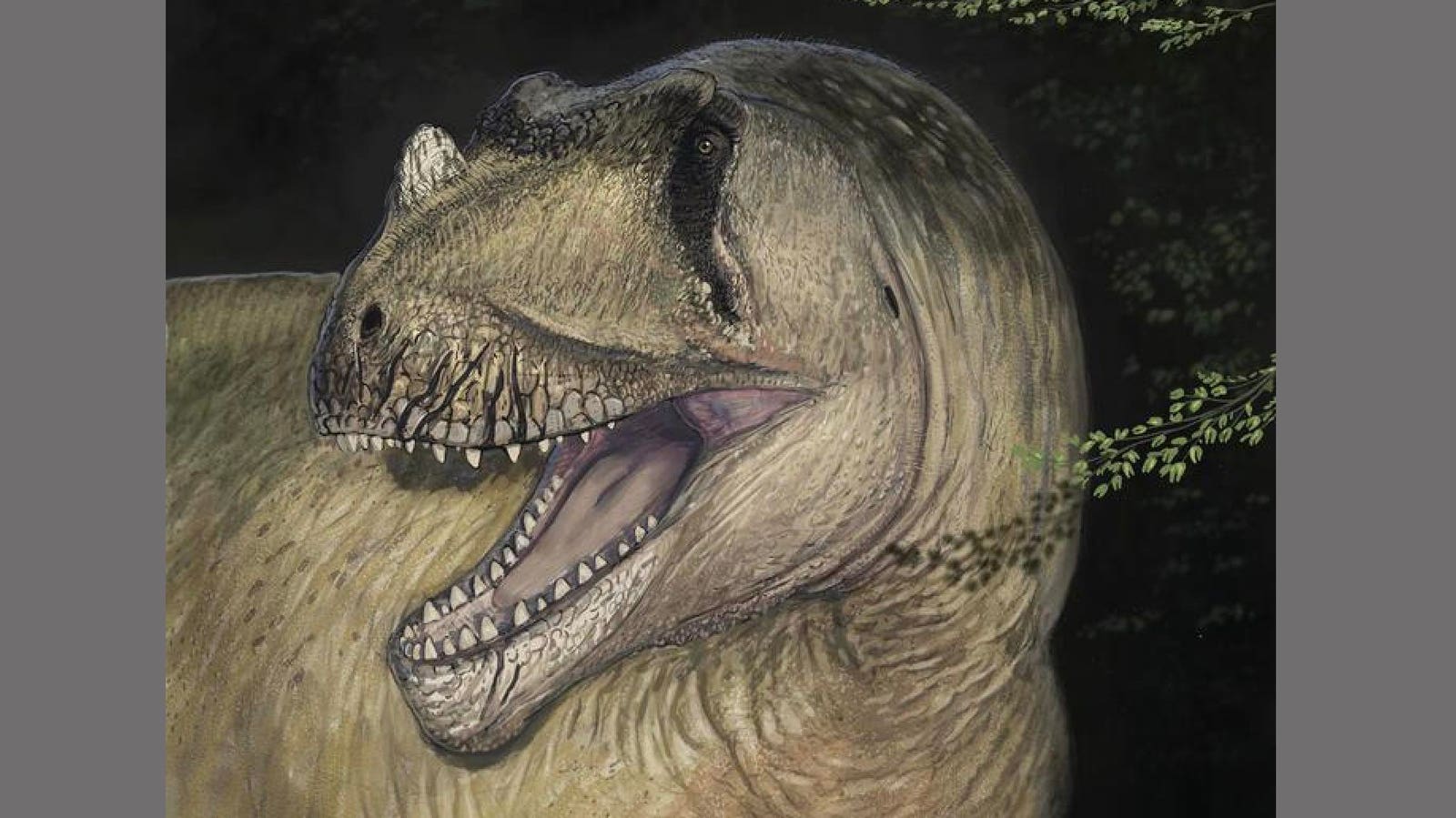
The dinosaur, which the scientists named Tameryraptor markgrafi, is a giant Egyptian predator from the Cretaceous period. It measured around 32 feet long when it roamed, had symmetrical teeth and a prominent nasal horn.
“Presumably, the dinosaur fauna of North Africa was much more diverse than we previously thought,” Oliver Rauhut, a dinosaur specialist from the Bavarian State Collection for Paleontology and Geology, said in a statement. “This work shows that it can be worthwhile for paleontologists to dig not only in the ground, but also in old archives.”
Rauhut is co-author of a peer-reviewed study on the find published last week in the journal Plos One. The fossil that led to the discovery has a dramatic backstory.
The beast’s remains were originally excavated in 1914 during an expedition to Bahariya Oasis, a site in Egypt’s western desert known for yielding other dinosaur bones, as well as ancient mummies and architectural treasures. Shortly thereafter, Munich paleontologist Ernst Stromer von Reichenbach studied the partial skeleton and assigned it to the genus Carcharodontosaurus, a large, carnivorous theropod that lived in Northwest Africa between 100 and 94 million years ago.
The remains were stored with other Egyptian dinosaur fossils at the Bavarian State Collection for Paleontology and Geology, which at that time was located in a building in central Munich. On July 21, 1944, however, an allied air raid hit the paleontological museum, destroying many of the fossils within, including Tameryraptor.
During new research all these decades later, Maximilian Kellermann, a master’s student at the Ludwig Maximilian University of Munich, came across previously unknown archival photos of the dinosaur from the Huene Archive at Germany’s University of Tübingen, which displayed them in the 1940s. The images capture parts of the original skull, spine and hind limbs before the skeleton was obliterated in the World War II bombing.
Kellermann evaluated the photos with Rauhut and Elena Cuesta, an LMU paleobiologist, focusing on features such as the nasal cavities, jaw and tooth curvature.
In some parts of the images, low exposure and fuzzy details made it difficult to discern certain features. But other elements, such as the angles of bones, were clear enough that the photos — together with Stromer’s old notes and illustrations — made it clear to the researchers the dinosaur pictured differs significantly from another Carcharodontosaurus found in Morocco in 1996 and officially named in 2007.
Through these comparisons, they concluded that Stromer’s original classification was incorrect and that they’d identified a completely different, previously unknown predatory dinosaur species.
“We took great care to not overinterpret things that were not 100 percent visible from the photos,” Kellermann said in an interview. “We left out any uncertainties for the codings in our dataset, treating them simply as ‘missing data,’ and indicated them in our description as such. Still, even with these uncertainties, it was clear that this was a different animal from Carcharodontosaurus.”
The first word in Tameryraptor markgrafi means “thief from the beloved land,” combining an informal ancient Egyptian name for Egypt (ta-mery), which translates to beloved land, with raptor, the Latin word for thief. Markgrafi honors fossil collector Richard Markgraf, who originally excavated it.
“The rediscovery of interesting anatomical features from photographs of long-lost specimens is rare and a bit unusual, but in some cases there are no better options for putting those specimens into scientific context,” Jack Tseng, a professor of integrative biology at the University of California at Berkeley who was not involved with the research, said in an interview.
Can A Species Reliably Be Named From Photos?
Paleontologists rarely name new species without directly studying fossils.
“In exceptional cases where the specimen in question is documented with an abundance of images and associated information, there may be a strong basis for erecting a new fossil species,” Tseng said. “In all other cases, there will always be a certain layer of uncertainty between the defining characteristics of new species identified from photographs and how trustworthy they might be when used in evolutionary analyses.”
In the new study, the researchers put their case in the “exceptional” category, detailing the reasons this dinosaur warranted a new nomenclature based on the available evidence. Chief among them is that Stromer’s descriptions and illustrations are highly accurate when compared with specimens that can still be studied firsthand, suggesting his data is a reliable complement to the photographs.
The material described by Stromer has played a pivotal role in understanding carcharodontosaurid anatomy, phylogeny and evolution, they say, making it all the more important the samples collected in 1914 are accurately categorized.
Kellermann said he’s excited that Egyptian colleagues are now working on collecting new fossils that could add to the scientific record and understanding of dinosaurs in the region.
“There is clearly a lot that we still don’t know about the dinosaurs in that area,” Kellermann said. “While there is still a bit of information to gather from studying the old literature and photographs, only new material will help shed a better light on this fascinating ecosystem.”
Read the full article here