


For Americans across the globe, Thanksgiving is synonymous with turkey dinners, family gatherings, and a celebration of harvest and gratitude. While most families give plenty of thought to the size, temperature, and fixings surrounding the turkey platter on Thanksgiving, few consider the ecological toll it took to get it there. So this Thanksgiving, it might be worthwhile to carve out a moment to ponder the ecological footprint of bringing the turkey from farm to your table.
Most turkeys in the United States are reared on factory farms where they live on a diet of crops grown specifically to feed animals. As much as 50% of a large poultry bird’s feed in the United States consists of corn. With rising temperatures impacting corn production and concerns about the land needed to meet the demands for feed-crop production, it’s unclear whether American households will have turkey in a few decades time.
How Climate Affects Corn Production
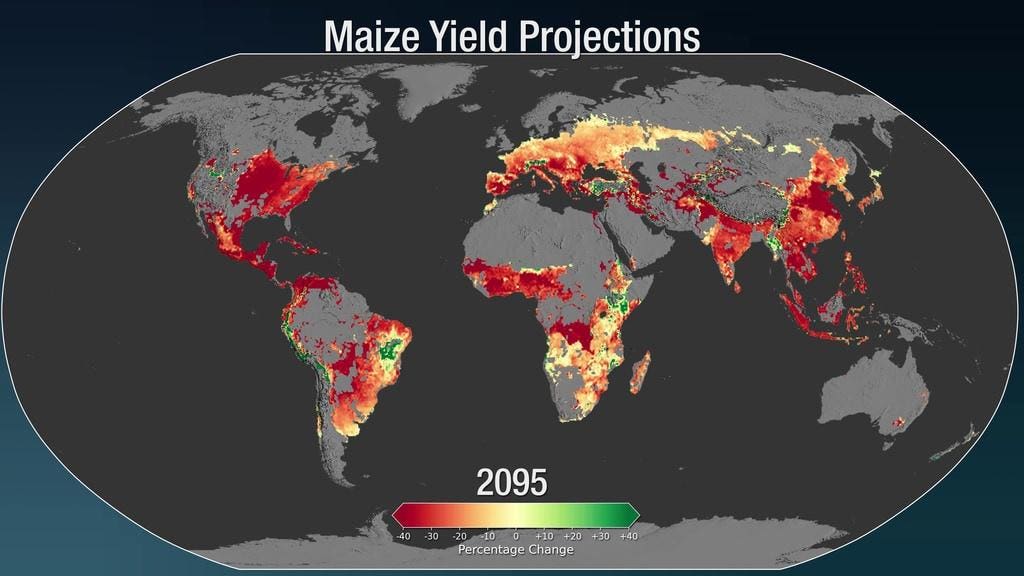
If global warming were to exceed 2 degrees Celsius, corn production in the central belt of the United States, where it is predominantly grown, can be adversely affected, say scientists. NASA reports that average global crop yields for corn may decrease by a quarter by late century if current climate change trends continue.
There are also studies showing that today’s corn belt could become unsuitable for production, driven by climate impacts such as droughts. For instance, the Midwest drought in 2012 drove up the price of corn to almost $8 per bushel, three times the usual price. As feed supply shortages increase with rising temperatures, the upward trend in the price can be expected to stay. A recent study shows that the livestock industry could face operating losses to the tune of $24.7 billion by 2030 mainly due to climate-change impacts on feed.
The Trade-Off Between Using Land For Feed Crop Versus Directly For Food
It’s not just the decrease in corn yields that is of concern. Many question whether U.S. land used for corn production is the best use of that land and if it would be better allocated for other food production. More than half of the almost 300 million hectares of U.S. farm land is used for corn and soymeal production. The actual farmed area used to produce food for human consumption is much smaller—about the size of Indiana, Illinois and half of Iowa combined. If the land currently used to feed livestock were used to grow food directly for human consumption—such as vegetables—it could increase available food calories by as much as 70%, potentially feeding an additional 4 billion people, according to scientists at the University of Minnesota.
Corn follows the practice of monocropping in the U.S., a method in which large amounts of land are used for producing only one type of crop, year after year. Ecologists warn against this practice due to its adverse consequences on soil biodiversity, which means it can deplete the soil of its nutrients and species variety. This monocropping culture has been supported by subsidies. Corn is the most subsidized crop in the country.
With growing concerns over climate change and the associated issues of food security and scarcity, economists and ecologists have been questioning these subsidies, which harm the environment. They express concerns over whether the expansion of corn cultivation is truly the best use of land.
Environmental Hazards Of Poultry Production
Phosphorus, a chemical found in the manure of poultry birds such as turkey and chicken, is a pollutant that poses a threat to water bodies. The waste from poultry farms is spread as fertilizer on nearby areas, as the general belief is manure is a good source of nutrients for the soil. However, phosphorus, which leaks out of these fertilizers, is a key nutrient also for algae growth in water bodies. Leakage of this chemical destroys water clarity and depletes dissolved oxygen. Poultry giants such as Cargill and Tyson have repeatedly found themselves in lawsuits for polluting local water supplies due to improper manure treatment. For instance, earlier this year, after 18 years, Oklahoma won its lawsuit against Arkansas poultry producers over the pollution of the Illinois River, which runs between the two states, according to a recent court ruling. Such lawsuits can be reputational risks for the survival of these firms.
This Thanksgiving, as Americans around the world express gratitude for their blessings, let the turkey centerpiece also prompt a moment of reflection on the trail of environmental challenges and the fact that the world is taking action. As the public, companies and investors become more aware of these issues, they’re holding each other accountable, and in this process, striving for a better planet.
Read the full article here