



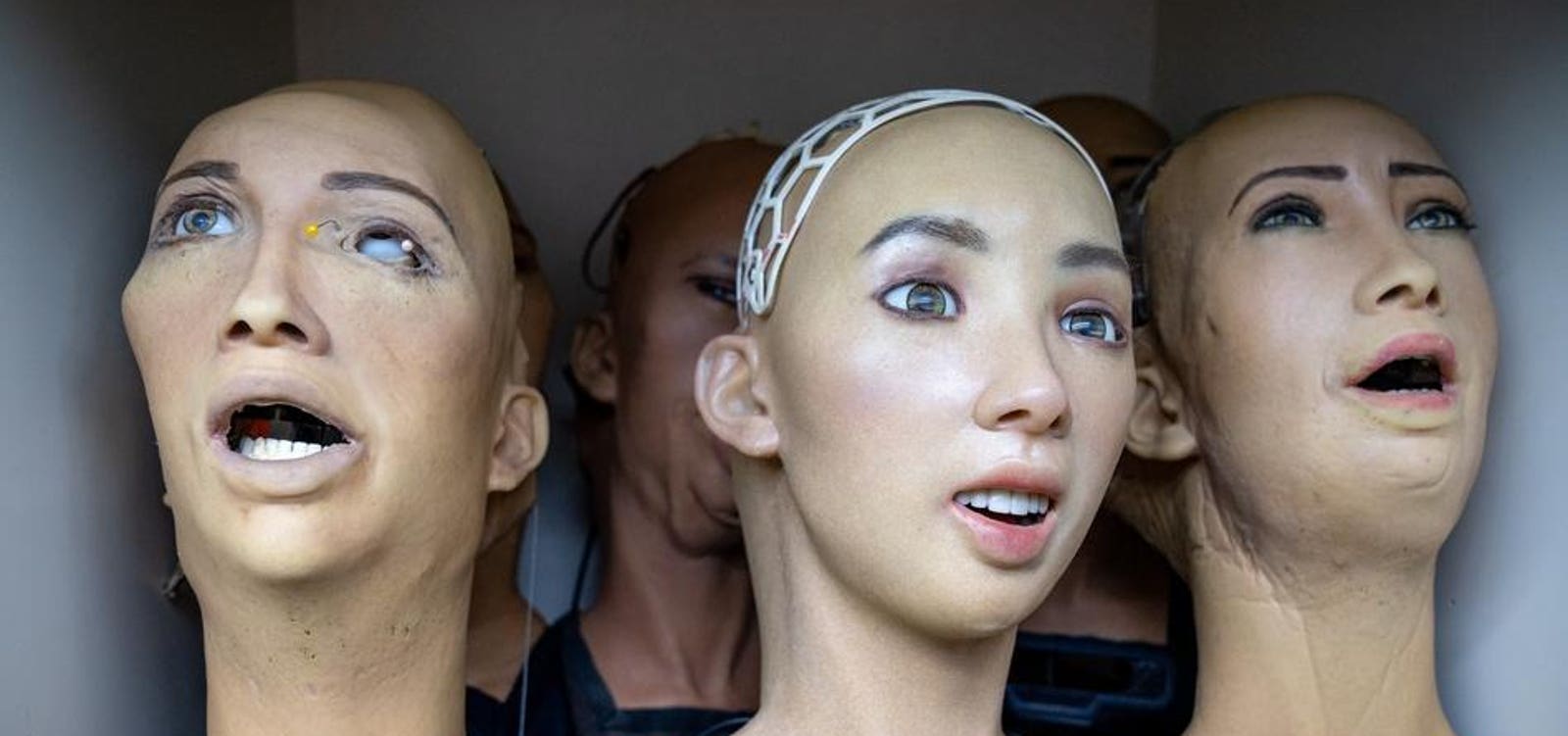
Developed by Hanson Robotics, “Sophia” is considered to be the most advanced humanoid robot to ever be created. With her human-like appearance and her astonishing imitations of natural facial expressions and gestures, she has left the world awe-struck.
Despite her brilliance, many can’t help but feel a sense of unease when looking at or interacting with Sophia. She appears nearly life-like, but not near enough. This very gap—being close to human but not quite—is what causes the sense of unease, and it’s referred to as the “uncanny valley.”
But what is it about the almost-but-not-quite human resemblance that triggers this unease in our minds? And how does the uncanny valley blur the lines between fascination and discomfort?
What Is The Uncanny Valley?
The uncanny valley hypothesis states that artificial characters and objects that are almost but not fully human-like will trigger a deep sense of unease. To depict this phenomenon, the research included a graph. The horizontal axis measures the humanness of objects—such as dolls, cartoons and robots—on a scale from zero to 100%. The vertical axis gauges our affinity for the object, with the top indicating strong liking and the bottom (or below) indicating dislike or discomfort.
As the humanness of an object increases to around 70%, our affinity rises steadily. However, at around 80%, affinity drops rapidly, but spikes again approaching 90 to 100% humanness, forming a “valley” on the graph.
Objects without human-like qualities don’t draw our affinity very well, like industrial robots—purely mechanical with no likeness to us. When objects weakly resemble real humans, like toys, stuffed animals or cartoon characters, we find ourselves increasingly drawn to them, feeling a sense of connection.
However, as objects reach that almost-but-not-quite human level, around 80 to 90%, an unsettling feeling creeps in. Objects like Sophia, Madame Tussaud’s wax figures or even prosthetics would sit within this valley.
At first glance, these objects seem impressively realistic. However, as we scrutinize their features, subtle imperfections emerge. Their expressions and details, though remarkably human-like, bear an eerie quality: a hint of life, but not quite genuine. This triggers a conflict in our brains between the appearance of humanity and the awareness that this object is, in fact, artificial.
As these objects teeter on the edge of the uncanny valley, our affinity for them takes an unexpected turn. The discomfort sets in, manifesting as an unsettling feeling in the pit of our stomachs. It’s a reaction born from the clash between expectation and reality, a psychological response to an almost-human entity falling short of complete authenticity.
Why Do We Experience The Uncanny Valley Phenomenon?
According to a review presented at the International Conference on Human-Computer Interaction, the phenomenon of the uncanny valley can be explained from two perspectives: one of evolutionary psychology and one of cognitive conflict. From the evolutionary psychology perspective, two hypotheses emerge:
- The Threat Avoidance Hypothesis posits evolutionary pressures, driven by the threats of diseases and death, shape our unease with humanoid objects. Pathogen avoidance suggests imperfections in human-like entities trigger associations with diseases, with the fear such entities could transmit illnesses. Mortality salience links the uncanny feeling to anxiety about death, particularly when humanoid objects resemble deceased individuals.
- The Evolutionary Aesthetics Hypothesis delves into the influence of physical attractiveness on our perception of humanoid objects. For instance, highly attractive robot images consistently receive low eeriness ratings, as judged based on traits such as symmetry, facial proportions and skin quality. These traits, molded by natural selection, play a role in shaping our affinity towards and perception of almost-human entities.
Two more theories emerge from the cognitive conflict perspective:
- The Mind Perception Hypothesis proposes human-like objects appear uncanny because they seem so realistic that people might think they have the ability to feel and sense like humans. However, this attribution of human-like feelings is unsettling because it goes beyond our expectations for robots. While people are comfortable with robots performing human-like tasks, the idea of them having human-like feelings creates discomfort.
- The Violation of Expectation Hypothesis suggests people have specific expectations for humanoid entities. For instance, we expect humanoid robots to move and speak smoothly like humans. However, these expectations are often violated, with robots moving mechanically and having synthetic voices. This mismatch between expectations and reality leads to negative emotions, avoidance behaviors and feelings of eeriness.
The unease of the uncanny valley that permeates our perception of artificial entities arises from our innate capacity to recognize and decipher human traits, as well as to protect ourselves from the unknown. Near-human objects tread into a perceptual gray zone, an ambiguous territory that blurs the boundaries between the familiar and the unfamiliar.
Conclusion
As products of evolutionary design, our brains are finely tuned to navigate our social landscape. In an interplay of recognition and interpretation, the uncanny valley phenomenon emerges. We respond with heightened sensitivity to subtleties deviating from the familiar human experience. The result is not just an uncanny feeling, but an instinctive wariness, as our mind grapples with the recognition of almost-human entities that fall just short of the genuine, sounding an alarm telling us that something isn’t quite right.
If the uncanny valley piques your interest, take this questionnaire to find out what other creepy, disturbing, or even grotesque things make you tick: The Morbid Curiosity Scale
Read the full article here