


If you haven’t noticed, there’s renewed interest in tablets and foldable running Android. Why has there been a resurgence, what changed, and how is Google approaching larger screens in 2023? I recently sat down with one of Android’s Product Managers (for Android on Large Screens), Andrea Zvinakis, to find out.
Note: Some quotes have been lightly edited for clarity.
It’s fair to say that Android-powered tablets have been competent but not stunning. Samsung has carved out a solid base with the various Galaxy Tab products, but Android tablets have not captured the imagination like the iPad.
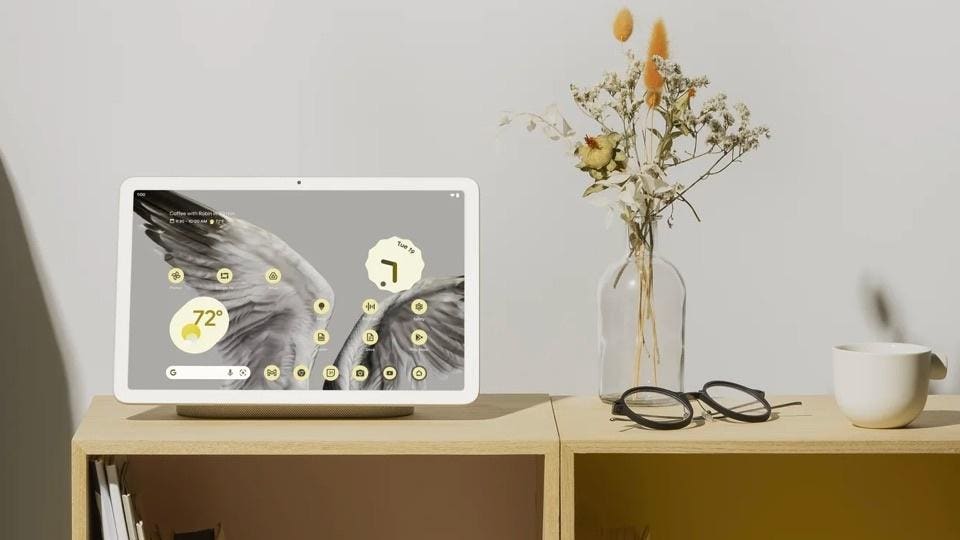
The last twelve months have signalled a change is in the air. More manufacturers, including Google with the Pixel Tablet, have moved into the tablet space. What changed? Zvinakis looks back and highlights one of the significant pivots.
“Last year, we launched Android 12L, which offered Android support for large screens. It indicated to the ecosystem that we are committed to large screens from that point onwards. It included refreshed surfaces across the operating system, the taskbar was added for improved multitasking, and then the app compatibility mode ensured that when using an app, it was optimised for the larger screen while still offering a great experience.”
What kicked off this increased attention on Android’s ambitions beyond the smartphone screen? It’s an answer familiar to anyone looking at how work and productivity have changed over the last few years… the impact of COVID and the rise of working from home.
“A lot of the change is wanting to have these more flexible devices,” Zvinakis explains. “Basically a lot of these signals were coming together to say “hey, this is a really big area to invest in” which resulted in Google taking larger screens really seriously from a tablet and a foldable perspective.”
With the renewed focus on Android’s tablet designs, I would imagine that every area of the operating system was up for discussion. Everything still has to feel like Android, but Google had an opportunity to help define the large platform for the modern mobile world. I asked Zvinakis about Google’s approach to reworking the user experience.
“We do a lot of internal testing, and we do a lot of refinement based on feedback we get, and that really dictates how the product is formed. We’ll do internal testing, bring people into the lab and really go through detailed scenarios. For the most part, if there’s a clear recommendation that most users really want – such as a behaviour in a particular way – that will become the default.
“If there’s a clear tension where there are two distinct groups of users that have strong desires for a behaviour to work one way versus another, that’s a good rationale to introduce an option or a setting.”
The Android software is just one of three critical parts in the package. The second is the apps; for many, this is the weakest part of the Android tablet experience. What does Google want to avoid, and how can it influence the app space in 2023?
“We didn’t want just to blow up a phone layout and have an extra-large layout on these larger screens. You really need to design for larger screens. Google is leading by example with our own apps, which helps us figure out the right app guidance. We really want to make sure there’s a consistency there, which is why we have quality guidelines published.”
The final part of that triplet is the hardware. As with smartphones, Android is used by many original equipment manufacturers, and they all have their own flavour of Android on their devices. As it is with smartphones, so it is with tablets and foldable. This means Google needs to create an experience that can be both unique and comfortable across the ecosystem.
“We are working closely with our OEM partners. What should the interaction patterns be for each of these services, like how should multitasking work? We wanted users, whether they pick up a Google tablet, a Samsung tablet, or another tablet OEM to have a great experience and don’t have to relearn the system every time they open a tablet. We create the features, ship them out to the ecosystem, and manufacturers usually do their own re-skinning.”
The rejuvenation of Android for large-screen devices came into sharp focus during this year’s I/O developer conference with the launch of the Pixel Tablet and Pixel Fold and more details on Android’s support for these device classes. The former highlights Google’s current focus, while the latter offers more tools and direction towards developers, as Zvinakis reminds me.
“What you are seeing now, with the latest launches, it’s basically Google’s commitment to large screens. Last year, we wanted to indicate to the ecosystem that we’re really serious with these latest launches at I/O for the Pixel Tablet and the Pixel Fold.
“Google committed to getting apps on board, particularly third-party apps; those are super important. We wanted to make sure that Google sets a good example with our own first-party apps, so over fifty of our apps are optimised.”
Google has laid its cards on the table in software and hardware. Long-term partners such as Samsung, who has previously supported Android with tablets and foldables, are continuing to update existing devices and release new versions. Other partners, such as OnePlus, are joining in developing new form factors. As more devices are sold, there is an increasing user base that third-party developers can address.
I feel that if you want to look for a single that Google’s efforts around Android on tablets and foldables are paying off, it’s third-party apps and developer engagement. If they support the platform, that’s the final step in a virtuous cycle that will create the best user experience possible.
Now read my review of the new Pixel Tablet…
Read the full article here