


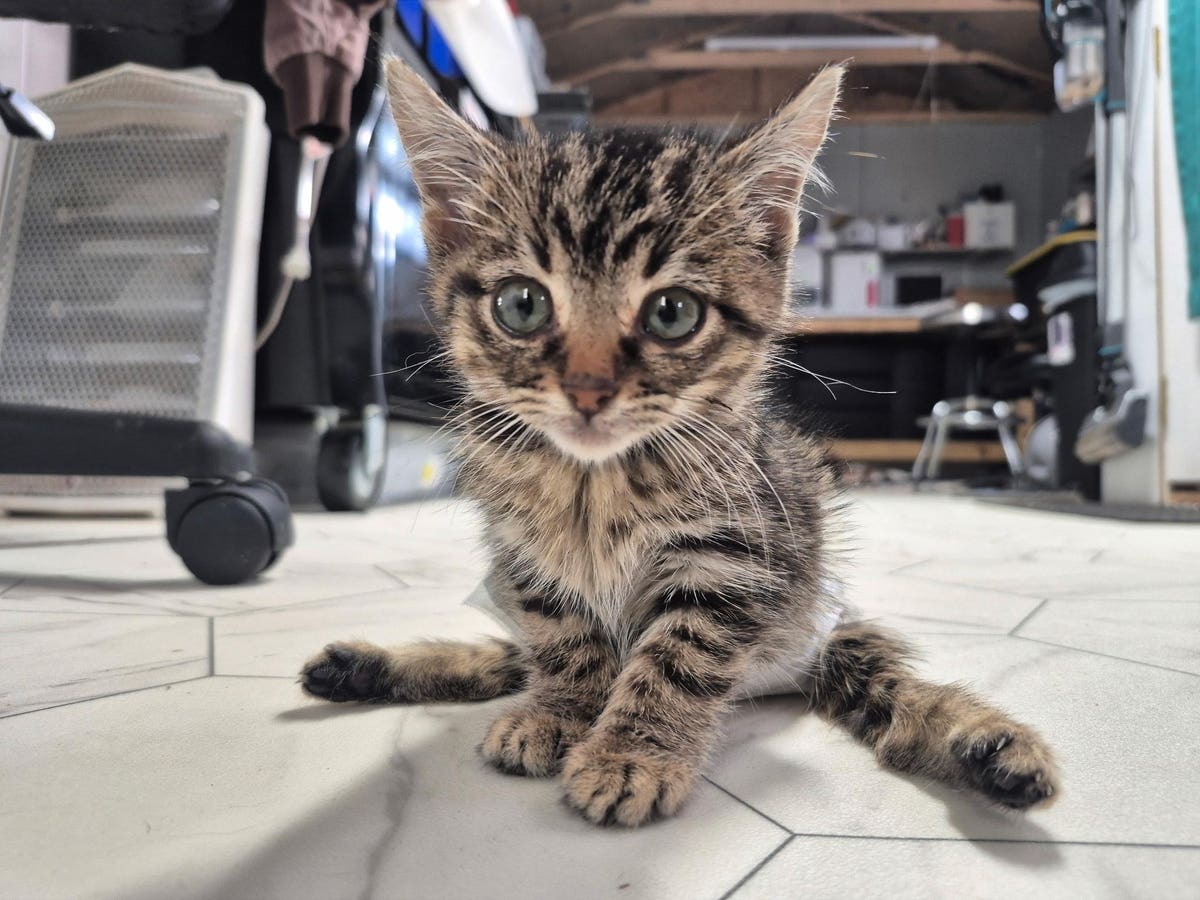
A tiny neonatal kitten named Brucey has had an oversized impact on kitten rescue.
Brucey and his litter of six kittens landed in an emergency veterinary clinic in Youngsville, Louisiana, after their mother died giving birth to them in the summer of 2024. The clinic put out a call for help on social media, and nursing school student Torie G. Roberts volunteered to take them into her home to bottle feed and nurture them.
“I grew up around animals. My family had a cattle business and a farm,” she said. “At a very young age, I learned that I was very good with saving kittens.”
Brucey only weighed a few ounces when Roberts brought him and his littermates to the home she shares with her husband, Alan Roberts. When the bitty kitty started to decline, she took him to see a veterinarian who diagnosed him with coccidia, a parasitic infection that can quickly lead to dehydration and death.
He started a medication but within a couple of hours, the kitten began having seizures. Back at the vet, euthanasia was on the table, but instead, the veterinarian installed a catheter so that Roberts could flush Brucey’s little 6-ounce body with IV fluids every two hours for three straight days.
It worked. But on the day Brucey made a turnaround, Roberts had to leave the house for about an hour for a doctor’s appointment of her own. While she was gone, her daughter’s young dog accidentally stepped on Brucey and crushed his skull.
Roberts was “completely devastated” that after 2 ½ weeks of constant care, Brucey was gone.
“I told myself, ‘I can’t do this anymore. I’m just not built for this. My heart is too big for this,’” she recalled. “And the next day I woke up and it was like a switch. It was like it happened for a reason to make me realize number one, what I’m capable of. Number two, what a little time and compassion can do for neonates and orphans. And number three, that this sacrifice can be beautiful.”
So she created the nonprofit Because of Brucey Neonatal ICU and Critical Care, which offers a 24/7 nursery and foster network to rescue neonatal kittens (newborns to 8 weeks old) and when they’re ready, adopt them into forever homes.
In its first 16 months, Because of Brucey has already saved over 500 lives.
Why Neonatal Kittens Need Help
Executive Director Jordan Speyrer shares her passion for saving neonatal kittens because so many need help. She said those young ones are often euthanized at animal shelters if kitten fosters aren’t available since “bottle babies” (typically under 4 weeks old) need to be fed frequently to avoid dangerous drops in blood sugar levels that can be fatal, and shelters don’t have the resources to care for them — or the kittens can die in the night if left in the shelter unattended.
Additionally, many kittens are born outside, and well-meaning people will take them to a shelter instead of leaving them outside with a mother to care for them, since the mom might be hiding or hunting for food. (Since removing kittens from their environment often isn’t the best thing to do, the ASPCA offers a checklist to determine when to take or leave kittens found outside, such as whether they appear sick or injured.)
“People will find a litter and assume they’re abandoned and they essentially kitten-nap them,” Speyrer said. “It’s an issue everywhere but it’s really, really prevalent down here in the South. We have a huge population of unfixed cats living outside and it’s just awful.”
After kittens complete a standard quarantine period with Because of Brucey to avoid potentially spreading diseases, they play with one another in the nursery rather than being confined to kennels. Prior to adoption, they are all spayed or neutered, vaccinated, dewormed and put on flea preventatives.
“Then they have a full life ahead of them. It’s the most rewarding thing. I love it,” Speyrer said. “And the kittens, they pay you back tenfold. They just love life and I mean, they’re the highlight of my day. They really are.”
Inspiring The Next Generation Of Kitten Rescuers
Speyrer’s 12-year-old daughter, Linden Speyrer, also loves spending time with neonatal kittens and helping them thrive. In fact, she’s the youth ambassador and an honorary board member for Because of Brucey because she’s been helping the nonprofit since she was 10 years old.
When asked what she loves about rescuing kittens, she replied, “Just being able to save lives and know that I’m making a difference to this animal.”
She even created a group called Kitty Quenchers to inspire young people to host lemonade stands to raise money for rural animal shelters in need and donate to a “Good Samaritan” fund at a local animal hospital to help people struggling financially pay for life-saving care for their pets.
“The goal for Kitty Quenchers is to raise money to help other rescues, and to just involve kids to help and support the community and animals,” she said.
Instead of having a birthday party when she turned 11, Linden and her friends canvassed the neighborhood with flyers asking for donations to Kitty Quenchers and worked with their parents to spread the word on social media. They raised over $1,000 for a rural animal shelter that “really needed it,” and it’s grown from there.
The young animal rescuer hopes to create her own nonprofit in the future, and Roberts is eager to mentor her with all she’s learned from founding Because of Brucey.
Brucey’s Legacy
Meanwhile, Roberts plans to continue growing Because of Brucey by transporting adoptable kittens north to cities with fewer pets available for adoption and creating kitten nurseries across Louisiana.
Because of Brucey has a high survival rate for kittens with panleukopenia, a viral disease that is highly contagious and fatal, so the nonprofit shares sanitation protocols and other best practices with other rescue groups. About half of the kittens taken in by Because of Brucey are not only medically fragile because of their age and size, but because of illness or injury.
Ultimately, Roberts is grateful to have found a way to channel her grief over the death of Brucey to help save so many more neonatal kittens.
“Once you see how preventable so much of this loss is, you cannot unsee it,” she said. “We’re building solutions where none exist.”
Read the full article here