



Topline
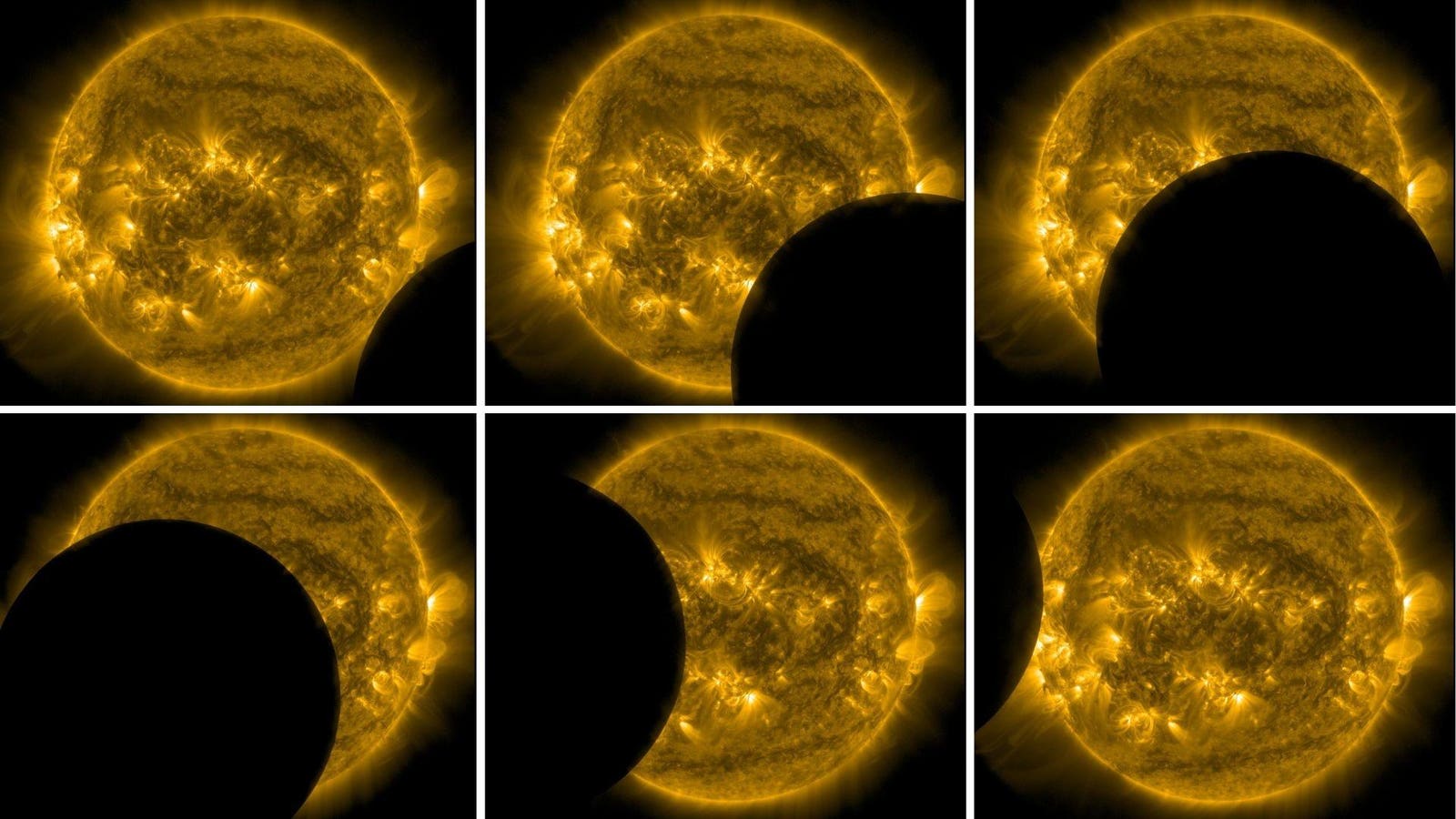
NASA’s Solar Dynamics Observatory has captured the moon eclipsing the sun in an event only observable from its position in space. At the height of the event on Friday, July 25, around 62% of the sun was covered by the moon. The SDO, which is solar-powered, coped with the drop in sunlight by having its batteries fully charged before the eclipse occurred.
Key Facts
The SDO sees several eclipses — or lunar transits — each year. This one was a deep partial eclipse, which lasted about 35 minutes. The SDO studies the sun’s atmosphere in various wavelengths of light.
The spacecraft is in a geosynchronous orbit around Earth, matching Earth’s rotation, and positioned 22,238 miles (35,789 kilometers) above a ground station in White Sands, New Mexico.
SDO has an almost constant but slightly different view of the sun than we do from Earth’s surface, but there are times when its orbit passes behind the Earth, causing an eclipse from its point of view. On July 25, SDO passed passed behind both the moon and the Earth on the same day, accotSDO.
The next solar eclipse visible from Earth will be a partial solar eclipse on Sept. 21, when up to 80% of the sun will be blocked by the moon as seen from New Zealand, Tasmania in Australia, the Indian Ocean, and Antarctica. Observers will need to wear solar eclipse glasses at all times, and all cameras and telescopes will need solar filters.
The next total solar eclipse visible from Earth will occur on Aug. 12, 2026, for parts of Greenland, western Iceland, and northern Spain. The maximum totality will be 2 minutes and 18 seconds off Iceland.
Europe’s ‘fake’ Total Solar Eclipses In Space
The European Space Agency’s Proba-3 mission — the world’s first precision formation flying mission — last month captured the first images of an artificial total solar eclipse from space. Proba-3 is a pair of satellites that fly in formation with millimeter precision, with one blocking the sun with an occulter disk and casting a shadow on a telescope on the satellite behind it. That allows it to image the sun’s corona — the sun’s outer, hotter but more tenuous atmosphere — which is only visible during a total solar eclipse. Although SDO can also see the corona, Proba-3 can see much farther into it, revealing what’s going on close to the Sun’s photosphere. That’s important because it’s there that the solar wind, solar flares and coronal mass ejections are produced. Proba-3 can produce a total solar eclipse lasting six hours once every 19.6-hour orbit.
Apollo 11’s Solar Eclipse In Space
Exactly 56 years ago this week, the crew of NASA’s Apollo 11 mission — the first to put astronauts on the moon — saw a total solar eclipse. On Jul. 19, 1969, Neil Armstrong, Buzz Aldrin and Michael Collins photographed a total solar eclipse on their way to the moon. Aldrin had seen a total solar eclipse from space before, on Nov. 11, 1966, during the Gemini 12 mission with Jim Lovell. The crew of Apollo 12 — Pete Conrad, Alan Bean and Dick Gordon — also saw a total solar eclipse from space on Nov. 24, 1969.
When Is The Next Total Solar Eclipse In North America?
The next total solar eclipse in the contiguous U.S. will occur on Aug. 22, 2044. The path of totality will begin in Greenland, travel through Canada’s Northwest Territories (with maximum totality close to Great Bear Lake, at 2 minutes and 4 seconds) and finish with an eclipsed sunset from Montana, South Dakota and North Dakota. Another total solar eclipse will occur across the U.S. a lunar year later, on Aug 10, 2045.
Read the full article here